
If you’re familiar with sea buckthorn (Hippophae rhamnoides, also called seaberry) shrubs, it’s probably because of the beauty and edibility of the berries, those brilliant orange pops of fruity sunshine. But, here on the prairies (and elsewhere in the country) June is the month to harvest and dry sea buckthorn leaves for tisane – well, the leaves from the male plants, that is. (Sea buckthorn are dioecious and flowers are borne separately on male and female plants. You need both to produce fruit. One male plant can pollinate up to seven females, and you need the wind to make the required pollen transfer). You can harvest the leaves from female plants, as well, but you must wait until autumn, after the berries are produced.

Sea buckthorn tisane is purported to be chockful of amino acids and antioxidants, and there are claims that it acts as an immune booster and an anti-inflammatory. Scientific studies are continuously ongoing. For now, I’m just going to enjoy the plant’s leaves and berries because they taste good and I have access to them. Many gardeners aren’t aware of the uses of this particular plant and might not take advantage of its edibility…as long as you’re absolutely certain of your proper identification of the plant, you may want to try it and see if you enjoy eating it. (If you don’t know for sure what you’re dealing with, please don’t sample it. That goes for every plant you encounter).
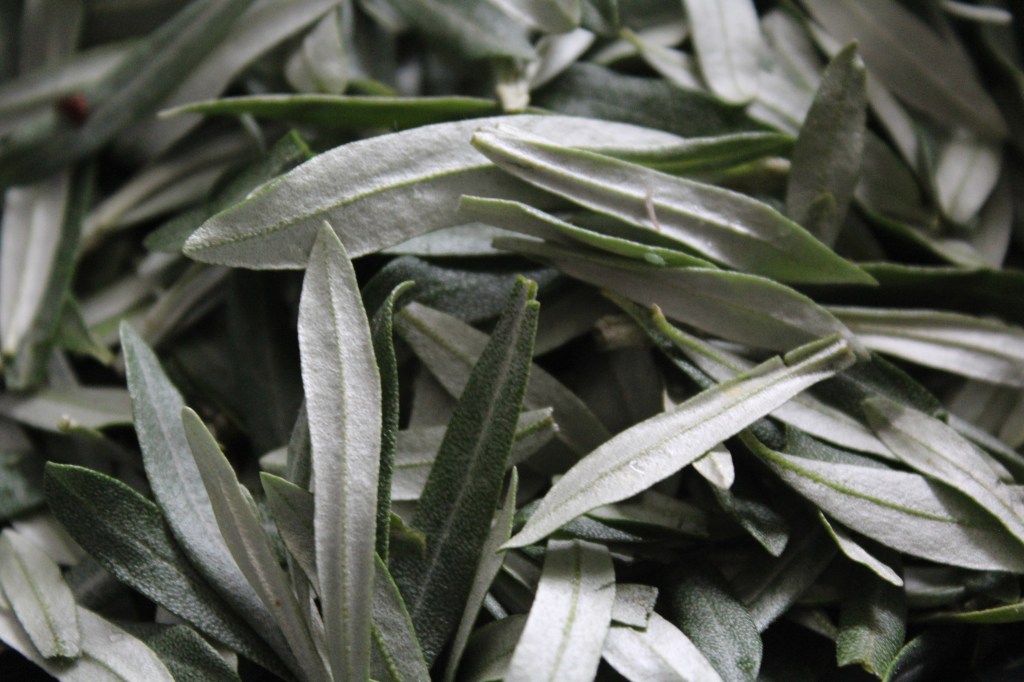
When you’re ready to pick leaves, you first need to figure out which plants are male. That can be a huge challenge unless you’ve purchased labelled male and female plants for your garden and you know which one is planted where. The females are the ones that produce the berries, but they don’t do that until nearly September. But – no fear! This website has some extremely helpful photos and information to differentiate the males from the females – check it out before you head out to do some harvesting.

Bear in mind while you’re picking to go easy on the plant and not remove too much – you never want to stress the plant by overharvesting. The plant needs a good canopy of those beautiful silvery-green leaves to conduct photosynthesis! For your first harvest, only take a handful in case you aren’t keen on the drink.

Wash the leaves well and pat them dry with a towel. Lay them out in a single layer on a wire rack and allow them to air dry for several days in a cool, dry location. You should turn them every couple of days or so. When it comes time to pack them up, store them in a clean, airtight tea tin and label the contents.

Once the leaves are dry and ready, brew them up to your preferred strength. You can enjoy them as is or make a custom blend by adding green tea leaves or dried fruit (why not try sea buckthorn berries?). A splash of locally-produced honey drizzled in hits the spot!

Do you grow sea buckthorn? Have you ever eaten the berries or used them or sea buckthorn oil in cosmetics? (I regularly buy a sea buckthorn lip balm from an excellent company in Manitoba).


14 responses to “How to: dry sea buckthorn leaves for tea (tisane).”

  1. natuurfreak2 Avatar

    Prachtig artikel

      1.  Avatar
        Anonymous

        Hi I am from Ladakh (India) and Ladakh is the Highest producer of sea buckthorn but here locals peoples don’t know the benefits and they don’t eat berries due to very sour taste so almost every plant go waste every year, Animals don’t eat either because of the thorn . So I want to make sea buckthorn tea to sell them , please can you tell me how to make tea for business

        1.  Avatar
          Anonymous

          Dry the leaves in a dehydrator. You can make one with a light bulb and a small fan in a tinfoil lined box. Once the leaves are dry they will snap in half when folded. If you grind them up to a powder you only need to add a pinch to tea. Like Macha powder. A little bit goes a long way. I use the berries mixed with either oatmeal or hazelnut flour and make little food bars. I use citric acid and a little salt as a preservative. Then vacuum seal them in tiny bags. These bushes are invasive. You only need to plant a couple and they will start sending out shoots and pop up all over the place.

    1. Aijaz Ali Avatar
      Aijaz Ali

      Hii i want to make sea buckthorn tea for business can you please tell me how to make it, because in my area there is a lot of sea buckthorn plants and here people don’t know the benefits and they don’t eat the berries also. So every winter all the plants die without any use . I am from Ladakh India

  2. Oh, the Places We See Avatar

    Fantastic! I learned something completely new today. (But you can bet I’d be the one who would confuse the male from the female plants!)

    1. Sheryl @ Flowery Prose Avatar

      LOL! It can be a bit tricky to tell them apart, that’s for sure!

  3. tonytomeo Avatar

    This is one that I have not grown yet. There is a native coffeeberry of the same genus, but I have never used it for anything. It was over harvested decades ago for some medicinal application that I do not remember.

    1. Sheryl @ Flowery Prose Avatar

      Rhamnus californica, is that right? I had to look it up, as I wasn’t familiar with it (we of course can’t grow it here due to our cold climate). Quite a pretty plant – the berries are gorgeous, and apparently the birds love them. I enjoyed reading about it – thanks so much for mentioning it!

      1. tonytomeo Avatar

        Yes, although it is sort of overrated. Only birds like the berries. I have found no good use for them. The wild sort do not make many berries. A dwarf cultivar is useful in landscapes, because, once established, it needs no water.

  4.  Avatar
    Anonymous

    Thanks, Sheryl,for the article. I have 3 trees on my backyard ( 2 of them are females ), so now I know another purpose for growing them except the berries they produce every fall time.

    1. Sheryl @ Flowery Prose Avatar

      You’re so very welcome!

  5. Mickey Moore Avatar
    Mickey Moore

    I love these berries! I don’t need any sweetener to enjoy them. I press the juice out of them mix with a bit of spring water and freeze in ice cube trays then package. I add one cube to a banana or other fruit and blend for a nutritious morning drink. I was curious about picking leaves for tea, now I know.

  6.  Avatar
    Anonymous

    I get the flu and Covid infections every five to six weeks that year me down for 2 weeks then reoccur. Have no life. Just live day to day have no addictions nor smoke. Got these berries right in my own shelterbelt snd must get the tea drying and help myself out. I’m only 66 years of age. 130 lbs. and have gluten intolerance that’s about it. I own and operate 3 sections of land and grow u a lot of organic grains. I’m female and quite happy other than for my reoccurring flu colds and flu infections. Help or suggestions very appreciated

Leave a reply to tonytomeo Cancel reply

This site uses Akismet to reduce spam. Learn how your comment data is processed.