
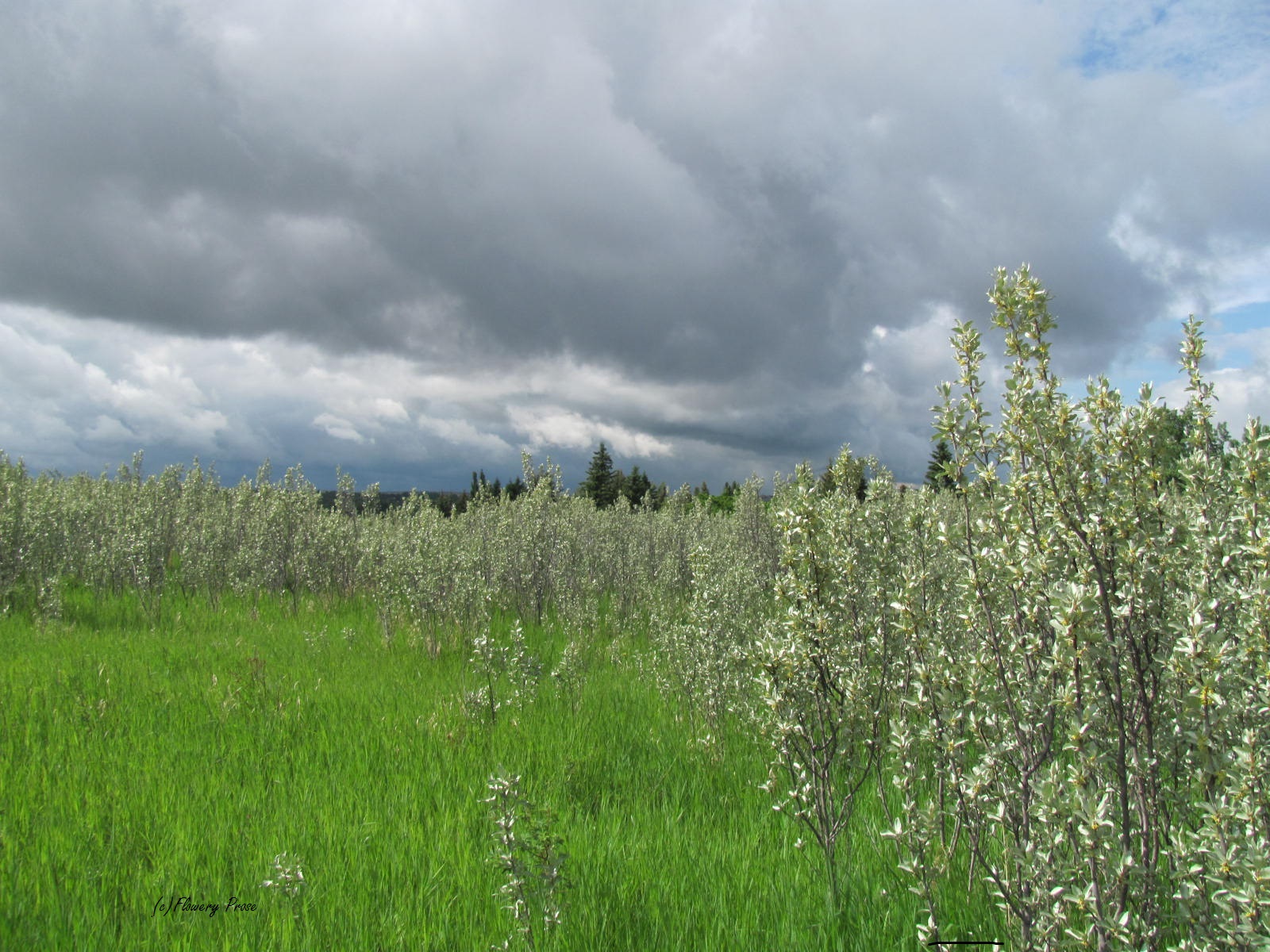
Although I wouldn’t necessarily recommend wolf willow as a worthy addition to most* gardens, you can’t deny its good looks. Especially against a stormy sky:
 

IMG_6541

Elaeagnus commutata (also known as silverberry) isn’t actually a willow at all – it’s a member of the Oleaster family and is related to buffaloberry (Shepherdia). While a beauty, it’s not an ideal ornamental in small gardens due to its invasive spreading root system, but if you have a large area with poor, infertile soil or a need for erosion control*, wolf willow may be very useful.  Proper siting is key!

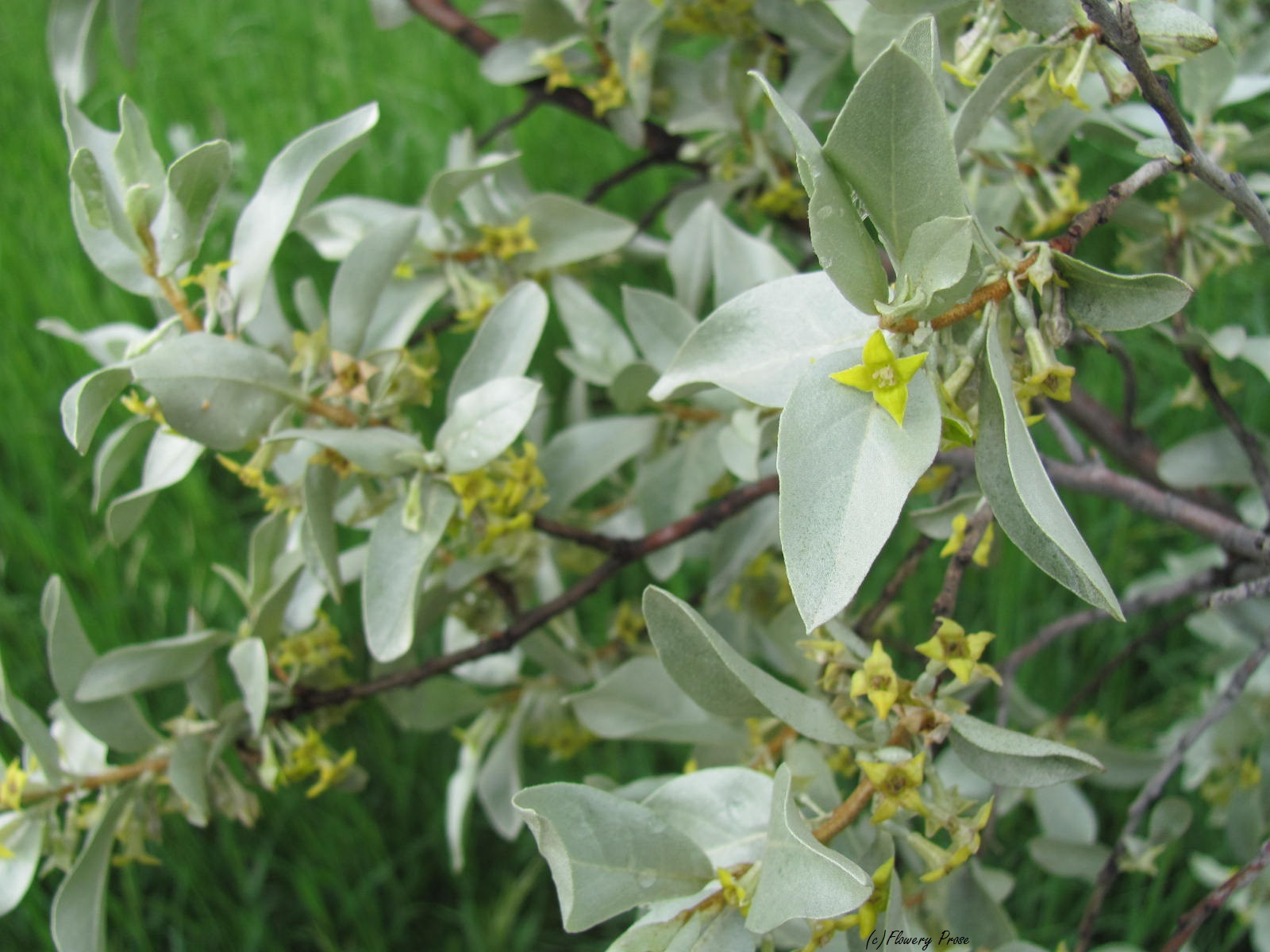
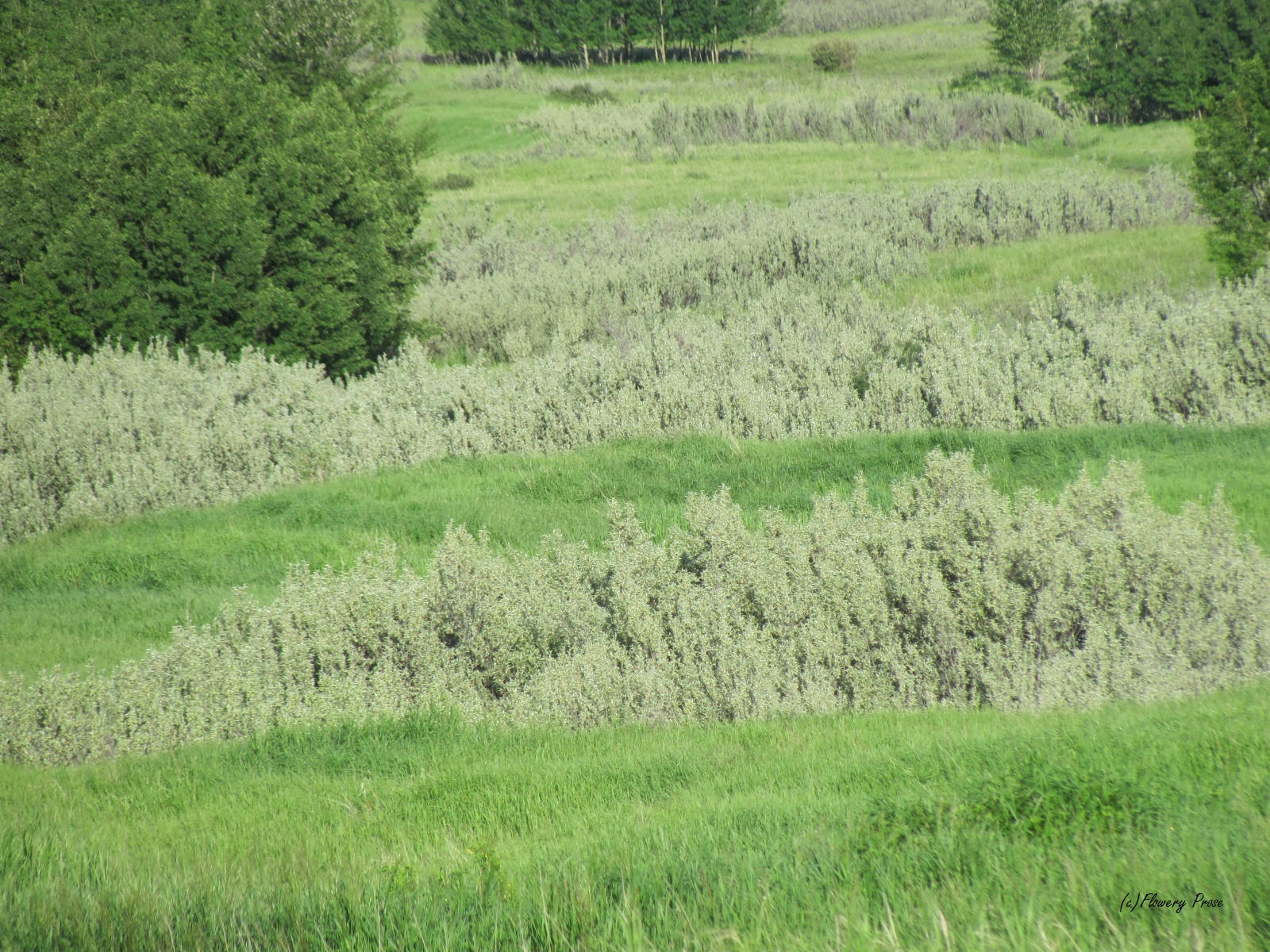
You’ll find wolf willow all over southern Alberta, often in open prairie. There are quite a few of them on the hillsides high above the riverbanks in Bowmont Natural Area here in Calgary‘s northwest, and several “groves” of them in Nose Hill Park.  Bloomtime is mid-June, and boy, are they ever making a show (and smell) of it this year!  (Might have something to do with the extra rainwater).  Wolf willow flowers have a sweet scent that can be rather overpowering in large doses.
IMG_6537

While rooting around the ‘net for some historical info about wolf willow, I came across several references to the shrub being used as decoration, food, and medicine by Native Americans.  Apparently, the berries were collected in the fall, boiled, and peeled to reveal the beautiful nutlets inside, dark brown seeds striped with bright yellow bands.  The seeds were pierced and used to make pretty necklaces often used as trade items, and they were often sewn onto garments.   (I will have to do some foraging later in the season and get my craft on!).  The berries were also mixed with animal fat and stored in a cool place to congeal, later enjoyed as a sweet.  Alternatively, the berries were cooked together with animal blood and eaten, which leads me to wonder what the berries taste like without the unappetizing additions.  (Apparently, my palate is picky).  Wolf willow bark was used to fashion baskets for transport and storage, and it was also made into a tonic to combat the symptoms of frostbite.¹
Wolf willow

Does wolf willow grow in your part of the world? Have you planted it in your garden?

¹http://plantwatch.naturealberta.ca/plant-information/wolf-willow


24 responses to “Wolf willow.”

  1. Christina Avatar

    Here in Italy we have a similar Elaeagnus, Elaeagnus angustifolia. It has very similar foliage, the flowers which appear in early summer are wonderfully perfumed. It too, suckers, so isn’t grat in a small space.

    1. Sheryl @ Flowery Prose Avatar

      Elaeagnus angustifolia is occasionally found here as an ornamental as well, but as you say, they’re a bit too much to handle in a small garden. They’re definitely pretty, though!

  2. Charlie@Seattle Trekker Avatar

    I have used Eleagnus pugens , Silverberry, or Silverthorn here in the Pacific Northwest in the US. It is not the best for gardens because of it’s invasive nature, but I would really recommend it for erosion control or use in large open spaces. The fragrance is absolutely wonderful.

    1. Sheryl @ Flowery Prose Avatar

      I checked Elaeagnus pungens on the ‘net, as I wasn’t familiar with them. I’m not sure how common they are here. You can find Elaeagnus angustifolia in the nurseries occasionally, but they’re pretty aggressive, as well. Does Elaeagnus pungens have white flowers or yellow like the wolf willow? I found some photos but couldn’t quite discern the colouration.

      In my search, I also found some variegated forms of Elaeagnus pungens at this link: http://www.thebritishgardener.com/2012/10/old-faithful-plants-elaeagnus-pungens.html; how interesting!

  3. Valorie Grace Hallinan Avatar

    Love the pictures, especially the first one.

    1. Sheryl @ Flowery Prose Avatar

      Thanks tons, Valorie! I took that shot the afternoon the rain finally stopped after the flood; the sky was just incredible.

  4. Forest So Green Avatar
    Forest So Green

    I have never seen this plant. I enjoyed reading your post. Annie

    1. Sheryl @ Flowery Prose Avatar

      Thanks so much, Annie! 🙂

  5. Cathy Avatar

    That’s a beautiful photo with the stormy sky. Interesting to read about this willow. I haven’t noticed it near us, although there are many types of willow down near our river.

    1. Sheryl @ Flowery Prose Avatar

      I’m not sure what its distribution is, world-wide, I should try to find out. It’s quite a striking shrub, you can see those flashy silver leaves from a long distance, and you’ll never find just a single specimen – I guess because they spread so easily.

  6. gardeninacity Avatar

    I don’t know this plant and don’t have it, but I enjoyed reading about it.

    1. Sheryl @ Flowery Prose Avatar

      I’m glad! It definitely has an interesting past!

  7. Time With Thea Avatar
    Time With Thea

    I had no idea the historical significance of this common Alberta plant. Thank you for your informative research and enlightening article. Very interesting…. Thea

    1. Sheryl @ Flowery Prose Avatar

      Thanks so much, Thea…I love it when I find these interesting tidbits of plant lore!

  8. Gallivanta Avatar

    A very useful plant, and pretty too. I suppose there is a wolf willow honey too.

    1. Sheryl @ Flowery Prose Avatar

      That’s quite possible! 🙂 The bees do love those little yellow flowers, that’s for sure!

  9. Flora Poste Avatar

    Never have seen this plant before! Thanks for great photo’s! Johanna

    1. Sheryl @ Flowery Prose Avatar

      I’m so glad you enjoyed them, Johanna! Wolf willow is quite pretty, I think!

  10. Donna@Gardens Eye View Avatar

    Our local environmental college is working on a project using local native willow that helps with erosion, acts as a snow shield and can be cut and used for biofuel…fascinating how useful plants can be instead of using chemicals and plastics and oil.

    1. Sheryl @ Flowery Prose Avatar

      It is really amazing and inspiring, isn’t it? Good to hear about these types of projects!

  11. Tom Namtvedt Avatar
    Tom Namtvedt

    In southcentral Alaska, wolf willow is found along glacial river beds like the Matanuska and Knik rivers. Very fragrant in spring, like cheap perfume.

    1. Sheryl @ Flowery Prose Avatar

      It does have a very distinctive scent – definitely instantly recognizable! Thanks so much for the comment, I appreciate it!

  12. natuurfreak Avatar

    Amazing place tot visit

Leave a reply to Christina Cancel reply

This site uses Akismet to reduce spam. Learn how your comment data is processed.