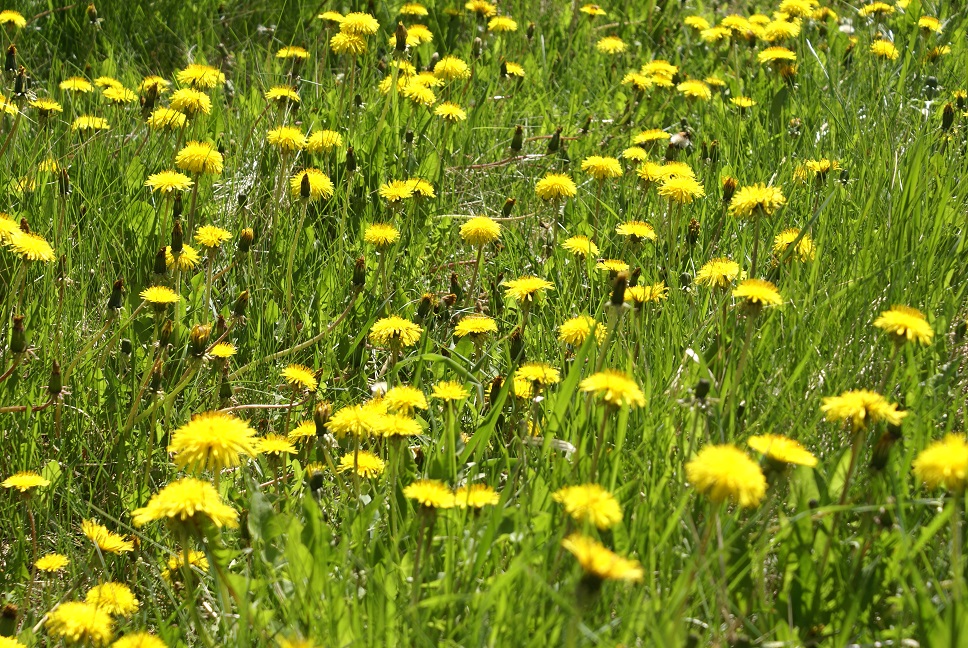
I’m revisiting an old post that usually sees a bit of traffic at this time of year…but it’s NEW AND IMPROVED! I’ve added a new photo and some new facts, and updated some links. ย I hope you enjoy the extras!ย 

SONY DSC

Dandelions, dandelions everywhere! The City has reduced its herbicide use over the past few years, which is a very good thing – dandelionsย are, after all, one of the best early pollinator plants around!

Just for fun, I dug up some Interesting Facts about Dandelions:

The name dandelion comes from the French “dent de lion” – lion’s tooth, which refers to the serrated leaves.

Another folk name for dandelion is “swine snort,” which makes me want to sneeze or giggle or both.

Taraxacum officinale is a perennial, but there are some dandelion species that are biennial.

If you mow dandelions, they’ll grow shorter stalks to spite you.

Dandelion pollen cannot cause allergies – the grains are far too large to be bothersome, but you can get contact dermatitis from the milky sap (latex) that the plant contains.

Dandelions open in the daytime and close at night.

Dandelion seed can travel up to 8 kilometresย (5 miles).

Dandelion flower heads can be used to make dye in the yellow-green range. ย The leaves will make a purple dye.

Dandelions will produce more seed than usual if their habitat is disturbed, giving them a competitive edge over other plants in the area.

Dandelions have a taproot which can extend up to a whoppingย 4.5 metresย (15 feet) underground, although you’ll typically find them top out at 45 cm (18″), which is still pretty long.

The taproot of dandelions is very useful to reduce compaction in garden soil.

Dandelions are dynamic accumulators – that means they can draw nutrients such as nitrogen from the soil and concentrate them in their leaves and roots.

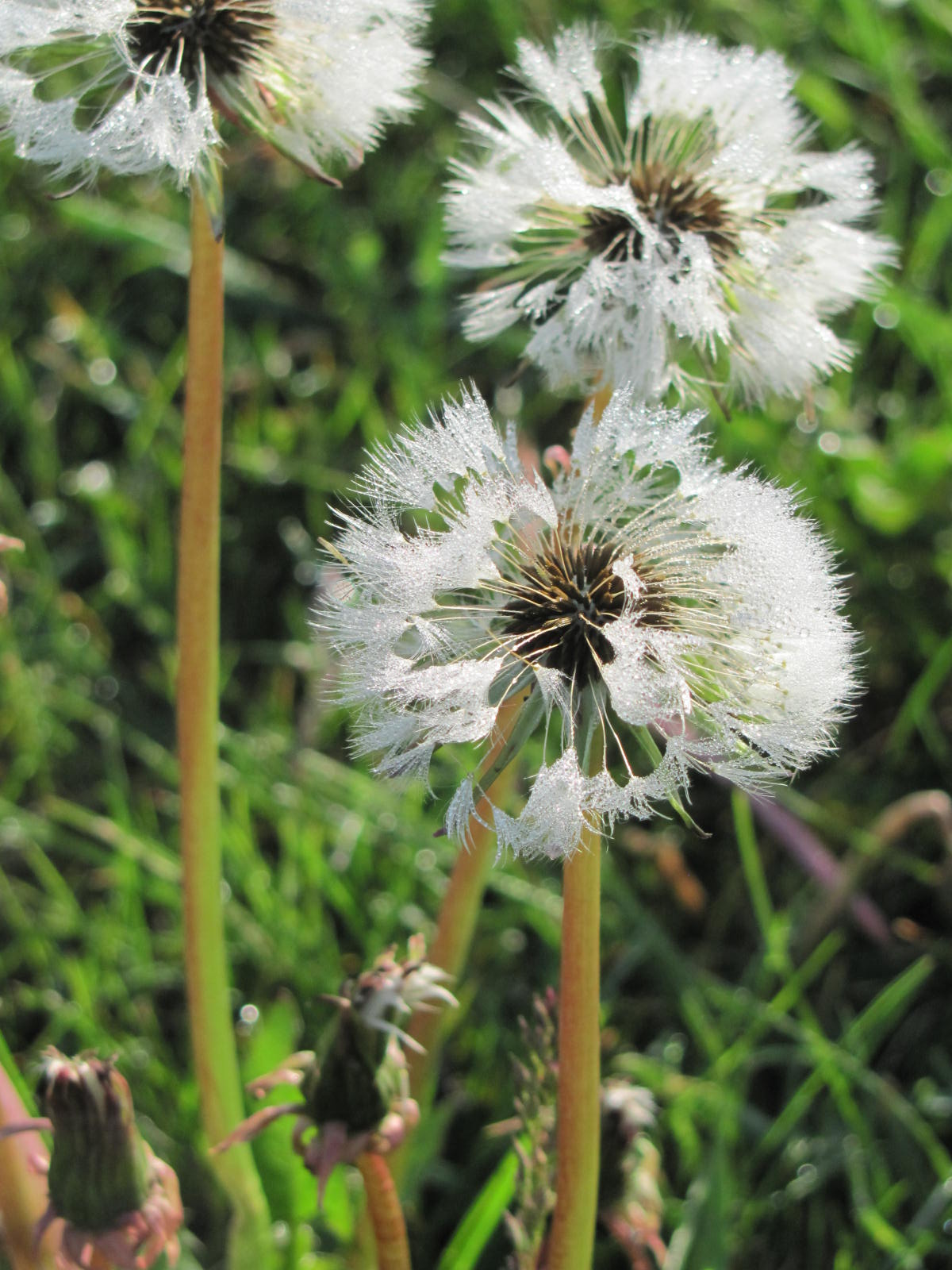
The parts of the dandelion apparently represent the celestial bodies: the yellow flower head is the sun, the white seed headย is the moon, and the seeds are the stars as they spread all over the galaxy (read: your lawn).

What we think of as the petals of a dandelion flower are actually individual flowers themselves. They will produce fruit called achenes, followed by the tiny, barbed brown seed and it’s accompanying “parachute” (called a pappus) that helps it disperse in the wind.

Dandelion flowers do not need to be pollinated to form seed.

Dandelions likely originated in Eurasia 30 million years ago.

Dandelions are known as ruderals or pioneer plants, the first to colonize disturbed land (such as after a wildfire).

Dandelion blossoms have been historically used to treat warts, clear skin complexion, and heal blisters.

ย I read that there is some sort of idea to use the latex in the future to make rubber tires for automobiles – we’ll see how that turns out. ย UPDATE: There is an article about the concept here.

Dandelion roots can be used as a coffee substitute, much like chicory.

I had no idea, but dandelion roots can also be used to make beer – here is one recipe I found, which also uses burdock roots.

Dandelion leaves are rich in vitamins A, C, and K, and the minerals calcium, potassium, iron, and manganese.

Some children’s books (fiction and non-fiction) about dandelions include: Joseph P. Anthony’s The Dandelion Seed, L. Kite’s Dandelion Adventures, and two sets of ย books with the same title, From Seed to Dandelion, by Jan Kottke and Ellen Weiss, and Dandelions, by Kathleen Kudlinski and Eve Bunting. ย I reviewed Kevin Sheehan’s The Dandelion’s Tale a few years ago on my now-defunct blog The Door is Ajar – you can find my thoughts here.

Did you know there is a dandelion tree? ย Well, not really…it’s another case of the utter inaccuracy of most common names. Despite this, Dendroseris pruinata is fascinating and rare, and you can take a look at some photos of it here.

According to the Guinness Book of World Records, the world’s tallest dandelion was grown here in Canada (in Ontario), and was found in September of 2011. ย It topped out at a whopping 177.8 cm (70 inches). ย Apparently, there have been at least two (maybe three?) record-breaking dandelions grown since then, but there is some dispute over whether any of them – even the record-holder – are actually dandelions at all. ย Read all about the controversy here! ย (This one in Norfolkย certainly seems a little suspicious…).
IMG_9132ย 

IMG_9144

I found this strange dandelion specimen on Nose Hill, in Calgary – it looks like it might beย a type of fasciation.ย  The fifth flower head actually drove through the centre stem, which was massively enlarged and already sported four joined flower heads.ย 

Thank you again for following Flowery Prose! ย I truly appreciate your readership! ย 


27 responses to “Interesting facts about dandelions.”

  1. The Canadian Cats Avatar

    Very interesting. The French Parsley and Poached Egg seeds have germinated already. No sign of the Hamburg Parsley but it hasn’t been that long.

    Jean

    1. Sheryl @ Flowery Prose Avatar

      So glad to hear! I sure hope the seedlings are doing well for you! Did the Hamburg parsley germinate, finally? I know it can take almost a month for it to appear….

  2. stbarbebaker Avatar

    Cool. I had dandelion pizza tonight. Not bad

    1. Sheryl @ Flowery Prose Avatar

      Did you use the leaves as a topping as you would arugula or spinach? Sounds tasty!

      1. stbarbebaker Avatar

        I do use the leaves of dandelion this way, right beside the kale, green peppers, mushrooms and plaintain leaves.

  3. kate@barnhouse Avatar

    Oh, so many fascinating facts about what lots of gardeners regard as their number one enemy. Thank you for rounding them up for us and for the links.

    1. Sheryl @ Flowery Prose Avatar

      I’m so pleased you enjoyed this post! It was fun to research and write. ๐Ÿ™‚

  4. Val Boyko Avatar

    Thank you for sharing this!!

    1. Sheryl @ Flowery Prose Avatar

      I’m delighted that you enjoyed this post!

  5. shoreacres Avatar

    Here in Texas, we have a native dandelion (Pyrrhopappus pauciflorus) that fills fields from horizon to horizon in the spring. It’s a glorious lemony yellow, with the same toothed edges, and it’s one of my favorite flowers. Here’s our little beauty.

    That sure enough is fasciation. I found a fasciated black-eyed Susan last weekend — the first fasciation I’d ever found. It seems to be more common than I realized. I’ll need to look more closely.

    1. Sheryl @ Flowery Prose Avatar

      Your native dandelion is definitely beautiful – I love that fantastic colour!

      I do believe this was the first fasciated wildflower I’ve ever seen…I have more often come across it in cultivated plants (most often Gerbera daisies). Like you, I’ll be watching for more specimens – it is interesting to see!

  6. Marion Alegria Avatar

    I never knew the dandelion could be so interesting.

    1. Sheryl @ Flowery Prose Avatar

      It is a truly amazing plant that perhaps doesn’t get the credit it deserves…. ๐Ÿ™‚

  7. Clare Pooley Avatar

    That Norfolk dandelion wasn’t a dandelion at all! I love all your dandelion facts!

    1. Sheryl @ Flowery Prose Avatar

      I can’t think how that Norfolk dandelion could have been so misidentified – and some of the other plants vying for records as well. So odd!

  8. natuurfreak Avatar

    Great information and amazing pictures.Thank you.

    1. Sheryl @ Flowery Prose Avatar

      I’m so glad you enjoyed!

  9. Born To Organize Avatar

    I learned so much reading this post, Sheryl. I’m stunned at the size of the tap root, but it does explain a lot. Right now I have several dandelions mixed in with the sweet peas and impossible to reach. Isn’t it amazing how much lore exists around this weed? What luck to happen upon such an unusually grown dandelion flower. That’s a great find.

    1. Sheryl @ Flowery Prose Avatar

      It is a surprising and fascinating plant, for sure, with a rich history and a bit of controversy thrown in…I know here in our city, there was a huge uproar again this summer because the municipal government refuses to spray them any longer (yay!). Due to several successive years of this practice, the plants have completely taken over every lawn and green space and many homeowners are not impressed. http://www.metronews.ca/news/calgary/2017/06/07/calgary-dandelion-calls-up-in-2017-goats-could-help.html. The city has rented goats for some areas but that’s not really a long-term, blanket solution….

      1. Born To Organize Avatar

        I love the idea of using goats. It’s a change in mindset I think, thought not without challenges. I’m happy to hear they’ve curbed the use of herbicides.

  10. digwithdorris Avatar

    Really fascinating. And you forgot to mention, picking the flowers makes you need to wee wee๐Ÿ˜‰

    1. Sheryl @ Flowery Prose Avatar

      LOL, yes! I must add that to the list…. ๐Ÿ™‚

  11. Tamara Jare Avatar

    Great post! here are some more recipes:First spring dandelion leaves are considered one of the best salads in my country, they are often prepared with egg or some peas or even cooked and sliced potato. Then others do prepare flower buds like capers, they are delicious. And from flowers syrup and honey -like spread can be made.

    1. Sheryl @ Flowery Prose Avatar

      I love this! Thank you so much for sharing these wonderful recipes!

      1. Tamara Jare Avatar

        You are welcome!

  12. Sheila Creighton Avatar

    They’re great plants – and the bees love them so I now leave them in my back lawn. ๐Ÿ™‚

    1. Sheryl @ Flowery Prose Avatar

      The bees will be delighted!

I’m delighted to hear from you – thanks so much for your comments!

This site uses Akismet to reduce spam. Learn how your comment data is processed.