mmfpnormandeau

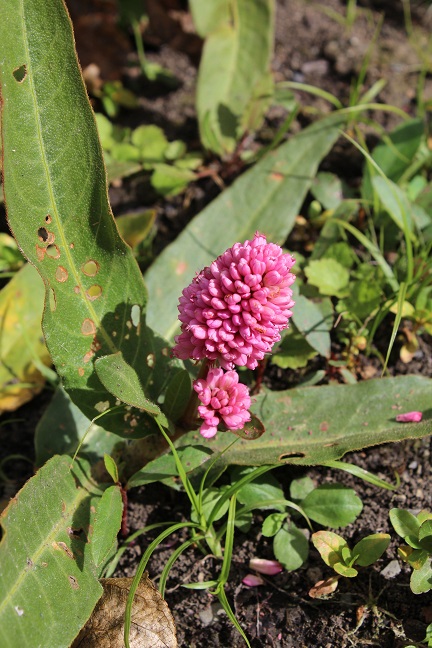
Back in September, I came across this water-loving marsh smartweed (Polygonum amphibium var. emersum) along the recently-flooded shoreline of Beaver Mines Lake in southwestern Alberta.  It’s not a plant I was previously familiar with, but I did some searching and found that it is a member of the buckwheat family and a North American native, alongside a large number of other smartweeds. According to my reading, some smartweeds are considered invasive species in certain provinces and states, but none seem to appear on the Alberta list.  Do any smartweeds grow where you live?


29 responses to “(Wild)flowery Friday: marsh smartweed.”

  1. insearchofitall Avatar

    It appears we have them here too. I probably wouldn’t know them if I saw them. 😦

    1. Sheryl @ Flowery Prose Avatar

      I would definitely walk right by if they weren’t in bloom – the leaves aren’t really remarkable.

    1. Sheryl @ Flowery Prose Avatar

      Perhaps they don’t grow there…I wonder?

      1. derrickjknight Avatar

        It seems to be native to USA and Canada

  2. kate@barnhouse Avatar

    We certainly do have a variety of them in the UK. Lots of gardeners see them as weeds but I like them and find they work well in looser meadow plantings. They very wildlife friendly, too😉.

    1. Sheryl @ Flowery Prose Avatar

      I can see them working well in meadow plantings…those flowers are striking!

  3. Laurie Graves Avatar
    Laurie Graves

    I’ve never seen one, either.

    1. Sheryl @ Flowery Prose Avatar

      Maybe they don’t grow there, I’m not sure. I was also thinking that I’m not sure how long they bloom. I think they would go largely unnoticed without the flower display.

  4. natuurfreak Avatar

    Super.But storms is coming this night en it wil be very cold.so I think:story is coming to an end.

    1. Sheryl @ Flowery Prose Avatar

      It was a nice stretch of beautiful weather while it lasted! Stay warm!

  5. Cathy Avatar

    We also have Polygonums here in Germany, but the native ones are not invasive. I do like the pink frothy flowers. I think the worst for spreading is Japanese Knotweed, which has been put under strict observation in the UK! I grow several Persicarias which used to be known as Polygonums, but are also quite harmless. 🙂

    1. Sheryl @ Flowery Prose Avatar

      Thank you for the great information! I had read some articles on Japanese knotweed while I was looking for details about this particular plant…that one is definitely a problem in many places! It’s interesting that the Polygonum genus was split at some point and the Persicarias are now separate. I found a list on Wikipedia and even if it’s not complete, it’s still lengthy: https://en.wikipedia.org/wiki/Persicaria.

      1. Cathy Avatar

        Thanks for that link Sheryl. The picture at the top (P. capitata) is one I grew as an annual once, but it dropped so many seeds that I kept finding little bits popping up in paving cracks near the patio for years afterwards! 🙂

        1. Sheryl @ Flowery Prose Avatar

          Sounds like the very definition of “reseeds freely,” lol!

  6. originalhortbabe Avatar

    In the 90’s when I was a hort student at Olds College, we had to do a plant collection. I was from North Battleford, SK and I found this plant along the river banks of the North Saskatchewan river.

    1. Sheryl @ Flowery Prose Avatar

      More evidence of their distribution on the Prairies…great information!

  7. The Canadian Cats Avatar

    I don’t remember seeing any of these in the bush but they seem similar to hyacinths.

    Jean

    1. Sheryl @ Flowery Prose Avatar

      Their flowers do have a similar shape, don’t they?

  8. arlingwoman Avatar

    We have them up and down the east coast of the US. They have a taller form than this plant and a longer flower form. They are pretty–I have seen them along river banks and on the shores of Lake Champlain. Nothing quite like this one, though!

    1. Sheryl @ Flowery Prose Avatar

      I looked at photographs of some of the different species – it surprised me how many there are, as well as how widespread their distribution is. Interesting plants, for sure….

      1. The Chatsworth Lady Avatar
        The Chatsworth Lady

        The one that arlingwoman describes is the one that’s pestiferous where I am. It’s Polygonum pennsylvanicum, although unfortunately it doesn’t limit itself to only that state, LOL.

  9. LB Avatar

    I’ve not seen one of these, but I’ll be on the lookout (next year). Beautiful image!

    1. Sheryl @ Flowery Prose Avatar

      Thank you! They definitely have distinctive flowers.

  10. clarepooley33 Avatar

    As Cathy says, we have a number of polygonums and persicarias in Britain and most of them are ignored and thought of as insignificant weeds. Japanese Knotweed is a terrible problem though but many people still wouldn’t recognise it. Locally to me I have seen Redshank (Persicaria maculosa), Pale Persicaria (Persicaria lapathifolia) and Knotgrass (Polygonum arenastrum). I am looking for a Polygonum to grow in my garden. Look at these! http://www.bethchatto.co.uk/o-r/persicaria-polygonum/

  11. The Canadian Cats Avatar

    Sheryl, I don’t have your e-mail but I nominated you for A Lovely Blog Award. The post will be out tomorrow.

    Jean

    1. Sheryl @ Flowery Prose Avatar

      I just had a chance to read your post! Thanks tons for the nomination – I really appreciate it!

  12. The Canadian Cats Avatar

    Can I gather your e-mail is right in your name….sorry I’m kinda weird at times.

  13. The Chatsworth Lady Avatar
    The Chatsworth Lady

    Smartweed is a real pest in the neighborhood I’m in now, although I never saw it in any of my previous gardens which were all less than 15 miles away. It may be because the soil in my former gardens was more well drained and less acid. But it is a terrible nuisance here.

Leave a reply to Laurie Graves Cancel reply

This site uses Akismet to reduce spam. Learn how your comment data is processed.