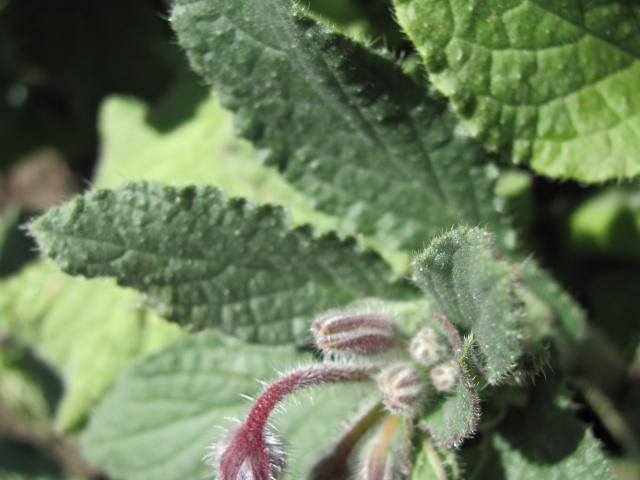
Mature borage leaves…edible, yes. But not terribly palatable.
An interesting/sort of crazy thing happened to me at the community garden the other day, and it got me thinking about how some people view so-called “edible” gardening. As I’m also smack dab in the middle of research for an article I’m writing about gardening for children, this particular incident had special significance.
A couple of visitors – a young mother and her daughter, who was about five years old – had stopped in to admire and photograph the giant sunflowers one of my fellow gardeners has growing in her plot. I was working alone in my plot at the time and the three of us got to talking about the plants everyone was growing, about the weather…the usual stuff. Suddenly, before I could say anything, the mother reached down and grabbed a borage leaf from one of my plants. “What’s this?” she asked, and proceeded to put the leaf in her mouth and chew.
Now, is it just me, or does this raise some alarm bells for you? Not only did the woman sample without asking me first (which rails against my sense of etiquette), but she started eating a plant that she wasn’t at all familiar with! And in front of her child, who was standing there watching her and being educated by her. Fortunately, as anyone who grows borage knows, the leaves are edible…although the mature leaves are seriously bristly and coarse and not really palatable fresh off the stems. (I ate the young leaves as microgreens and allowed a few plants to mature for the benefit of the edible flowers).
“Um, that is borage,” I said. “The leaves are not particularly tasty when the plants are older.”
The woman smiled shakily and fumbled in her bag for a water bottle. They beat a hasty exit out of the garden after that. I felt badly that she had a poor taste-testing experience, but her behaviour left me cold. Just because plants in a community garden are generally veggies, herbs, nuts, and fruits – considered EDIBLE plants – it doesn’t mean that all of the parts of these plants can or should be eaten. No one in the know would go up to a rhubarb plant and sample a section of a leaf, would they? But what if you weren’t aware that rhubarb leaves contain high amounts of toxic oxalic acid, and you just assume that everything in the garden is ripe for the eating? Other common toxic plant parts include the stems and leaves of potatoes, and the leaves of tomatoes – crops we grow in our community garden. Wandering around pulling a leaf here, a leaf there, may be a sure-fire way to get – at minimum – a serious stomachache, but it could actually be deadly if you’re not careful. Why would you risk that, and teach your children that it’s okay to eat any old plant, whether you know what it is or not?
Furthermore, while we do not use any sort of chemicals in our community garden, what if this had been a different setting and a gardener had, say, sprinkled an insecticidal dust all over his cabbage plants to control cabbage worm? Yikes!
What are your thoughts on the “inedible” aspects of edible gardening?


 Flowery Prose.