
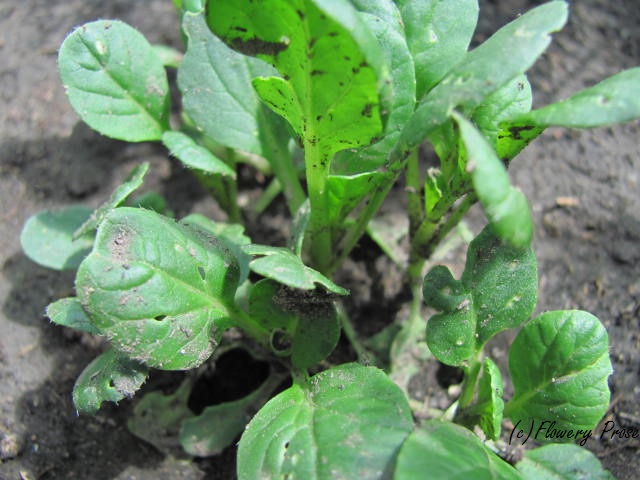
The brassicas in my community garden plot are currently under siege.
While my tatsoi and kale are perfectly edible, they’ve also been completely shot full of holes, due to a flea beetle infestation (thankfully, I’m not combating cabbage moth or cabbage white butterfly!). Yes, I ought to have put up a floating row cover, but in truth, I’m not particularly bothered. I’m only growing for my hubby and myself, and my plot is full of a variety of crops so a few nibbles in the cabbagy-plants don’t trouble me much. Besides, all of the other growers in the community garden have the exact same problem (except for the thoughtful ones, who did actually employ the row covers since the start of the season), so I don’t feel like I ought to have low self-esteem for culturing pocked plants.
I’m actually more worried about the onion maggot, which made an appearance in my shared plot last year. One of my fellow growers at the garden told me the other day that she just doesn’t “bother with onions anymore.” So far I haven’t seen any evidence on my plants, but it’s a lingering threat.
Our garden maintains a rigid “no-spray” policy – and I wouldn’t apply chemicals to veggies even if the restriction wasn’t in place. I try to grow as organically and safely as I can, and one of the tenets of organic farming is crop rotation. There is no crop rotation governance in place at our community garden, and really, even if there was, how could it be done so that the whole garden would remain pest-free? On a large-scale or commercial level, or even in a home garden, crop rotation may be a workable solution – but how do you effectively employ it in a community garden? This is my first year with this particular plot, and should I decide to continue gardening at the site, I will be allocated the same plot next year. And even if I were to ask for a different plot, it’s nearly a guarantee (just by looking at the produce in everyone else’s beds) that pest-susceptible brassicas and other plants are growing there right now – or were last year. The general rule is that brassica crops should not be planted in the same spot more than once in three growing seasons, so my fellow gardeners and I are pretty much hooped if we really want hole-free collards and cabbage. And it’s not just used to deal with pests – crop rotation is also often employed to rejuvenate nutrient-depleted soil, as veggie crops have varying nutritional needs.
Hand-in-hand with crop rotation is the employment of green manures – which, again, can’t really be used effectively in a community garden setting. No gardener is going to pay for the rental of a plot and grow clover or alfalfa or buckwheat on it just to till it over for the next season…unless the Garden Team designates a few plots each year for the purpose and does not rent them out. Our community garden currently doesn’t do this. (At home, growing green manures can actually work, and it may be worth giving over different parts of your garden beds over each year to pursue this great source of ready nutrition for future crops).
So, what is a workable solution? (Besides the floating row covers, which are on my list of “must-haves” for next year). I guess it all comes down to this: a happy plant gives you little or no strife, because it’s less susceptible to munching critters and diseases. If green manures are doable, use them. And amend, amend, amend. Make sure your soil is the healthiest it can be. I know I’m definitely guilty of not adding nearly enough compost to my plot this season, and the soil texture leaves a lot to be desired as well. Give plants a specific balanced diet of macro- and micro-nutrients. Keep on top of the watering and weeding. Plant crops at the right time of year, in the proper location, so that they have their best chance at thriving and producing. Try to ward off the baddies with intercropping or trap cropping.
And even with all of this, the pests may still come. It’s just part of gardening! 🙂
What do you think about small-scale crop rotation? Do you rotate your crops at home (or in your community garden plot)? Do you grow green manures?
Related articles
- Organic Pest Control in Gardens or Fields (slowmoneyfarm.wordpress.com)
- Handy Hints for Creating an Organic Garden (prfire.co.uk)


 Flowery Prose.